Sunday, April 6, 2008

CRES Wind Farm & Cape Sounion

A couple of weeks ago, my classmates & I traveled to Lavrio (around 30 miles / 45 km SW of Athens) to visit a renewable energy research park. The site includes a wind farm comprised of wind generators from several manufacturers and is operated by CRES (Centre for Renewable Energy Sources, www.cres.gr/kape/index_eng.htm), the local research institute where we recently received two weeks of wind energy lectures. The wind farm allows CRES personnel to examine wind turbine performance in a "complex terrain" (i.e. hilly, non-uniform landscape). They also have other RE experimentation and demonstration equipment at the site, such as a large photovoltaic array, a wood pellet furnace, a hydrogen fuel station, a solar cooling demo building, and wind-powered desalination equipment.
.

N-E-G Micon turbine (with blade tips turned for braking)
.

Enercon wind turbine
.

Wider view of the CRES wind farm
.

Checking out one of the PV arrays
.
After the research park visit, we ate a late lunch at a seafood restaurant overlooking the Aegean Sea. Finally, we visited the Temple of Poseidon at Cape Sounion on the southern-most tip of Attica (the prefecture in which Athens resides). It's a place that Lord Byron wrote about in Don Juan: "Place me on Sunium's marbled steep, where nothing save the waves and I, may hear our mutual murmurs sweep..." It's a really beautiful spot, and thankfully this was a nice, sunny afternoon. It's supposedly quite a nice place to watch the sunset, although I didn't stay late enough to witness this.
.

Poseidon's Temple
.

Temple from another view
.

Not a bad view from Poseidon's place
.

The Windies

Monday, March 24, 2008

Mt. Imitos Promenade

Two weeks ago, while two good friends from Oregon – Vernon & Rosy – were visiting me in Athens, a group of my classmates organized a Sunday afternoon hike to (nearly) the top of Mount Imitos. Imitos is a broad mountain, which lies to the west of the city, not far from our apartment. It was a beautiful, sunny day, so we got some nice views of Athens and of the sea (to the SW). Here are some pics from our stroll:
.

L-R: Laurent, Emma (front), Marion (back), Xavier, Fernando, François, Antoine, Nora, Filippo, Scott, Rosy (photo by V. Reitz)
.

Lunch break near the peak
.

On top of the world (photo by R. Mazaika)
.

Eastward toward Athens
.

Trees & concrete (photo by R. Mazaika)
.

Facing southwest (Aegean Sea reflecting sunlight at the middle-left)

Greek alphabet… or rather alpha-veet

Ever since my arrival in Athens, I’ve had a goal of learning to read Greek. Now, that doesn’t mean I have any illusions that I’ll actually learn to speak Greek in four months… but it means that when I see street or storefront signs spelled with Greek letters, I should be able to properly pronounce these signs. As someone who’s studied a fair amount of math and science, I assumed (before arriving): “Greek letters, no problem: there’s alpha & beta, gamma & delta… mu [myoo], nu [nyoo], pi [pie], rho [row], & sigma… phi, psi, theta, zeta… a few other obscure letters… & finally omega.”
.

What I didn’t realize is that we, non-Greeks have been taught pre-modern (and in some cases: simply wrong) pronunciations for the Greek letters we use in math and science formulas (or for fraternity/sorority names). Here are a few examples of my surprises and confusions:
  • B/β isn’t pronounced “beta” or “baytah”; it’s “veeta”
  • Г/γ isn’t “gamma”; it’s “rhahmah” (starting with a French-sounding guttural “r”); but if followed by I/ι or E/ε, it sounds like the English “y” (as in “yo, baby”); if it’s doubled (γγ) it sounds like “ng”, as in “hang loose”; if it’s paired with a kappa – γκ – then, and only then, do you pronounce it as a hard “g” (as in “gimme, gimme”)
  • “Delta” (Δ/δ) is actually pronounced “thelta” (a voiced “th”, as in “these”)
  • Θ/θ is theta – pronounced “thaytah” (an unvoiced “th”, as in “thanks”); this is actually the way we’re taught to pronounce this letter in school… but it’s a little confusing, because there’s such a small, subtle difference between this sound and the “th” sound made by Δ/δ.
  • M/μ isn’t pronounced “moo” or “myoo” but “mee”
  • N/ν, likewise, is “nee” (as in “the knights who say…”), not “noo” or “nyoo”
  • T/τ doesn’t rhyme with “cow” (as in “Townsend”); it’s pronounced “tahv” or “tahf”
  • If you want to make an English “b” sound in Greek, you have to use a letter combo: MΠ/μπ
  • P/ρ is rho (pronounced like a Spanish “r”), not like “p”, as it looks
  • If you have the equivalent of an English “s” (Σ/σ, pronounced “seegh-mah”) at the end of a word (when written in lower case), the letter takes a different form: ς.
  • There are (at least) six letters and letter combinations which make the “ee” [i] sound in Greek: H, I, Y, OI, EI, YI (η, ι, υ, oι, ει, υι)
  • If you see the letter Y/υ, it can be pronounced “ee”, “oo”, or “f”, depending on adjacent vowels (Y or YI = “ee”; OY = “oo”; AY = “af”; EY = “ef”)
  • All Greek letters that we typically pronounce with a long "i" sound (as in "high") -- phi, pi, psi, & chi -- actually have the "ee" sound (e.g. fee, pee, psee, & khee)

In addition to confusion over letters, the Greek words for “yes” and “no” sound remarkably like their English opposites: NAI [pronounced neh] means “yes”… while OXI [pronounced approximately like okie, as in “okie-dokie”] means “no”.

But one helpful thing about Greek pronunciation: If a word (with more than one syllable) is written in lower case, an accent mark is always placed over the vowel within the stressed/accented syllable. So when you see the word for “thank you” in writing – ευχαριστώ [pronounced ehf-hah-ree-STOH] – you can tell by the accent mark that you’re supposed to emphasize the last syllable, “STOH”.

Now that you’ve had a quick lesson in reading Greek, here are a few words to let you test your Greek sign-reading skills. All of the following words are also used in English (but sometimes the Greek version has an additional flourish at the end, such as “a”, “i”, “o”, “as”, or “os”). I’ve tried to arrange them from easiest to hardest:

  1. καφέ
  2. oύζo
  3. Aθήνα
  4. ταβέρνα
  5. Aκρόπολις
  6. Kόρινθος
  7. μπύρα
  8. Mαραθώνας
  9. αρχαιολογία
  10. αμφιθέτρο

Ready for the answers? Scroll down a few lines…
.

.

.

.

  1. καφέ 8 café [kah-FAY]
  2. oύζo 8 ouzo [OO-zoh] (licorice-flavored Greek liquor)
  3. Aθήνα 8 Athena [ah-THEE-nah] (a.k.a. Athens; also the goddess)
  4. ταβέρνα 8 taverna [tah-VEHR-nah] (Greek for tavern/pub)
  5. Aκρόπολις 8 Acropolis [ah-CROW-poh-lease]
  6. Kόρινθος 8 Corinthos [COH-rin-thoce] (Greek for the city of Corinth)
  7. μπύρα 8 bira [BEE-rah] (Greek for beer)
  8. Mαραθώνας 8 Marathonas [mah-rah-THONE-ahs] (Greek for the city of Marathon)
  9. αρχαιολογία 8 archaeologia [ar-kheh-oh-low-HYEE-ah] (Greek for archaeology)
  10. αμφιθέτρο 8 amphithetro [ahm-fee-THEH-troh] (Greek for amphitheater)

Saturday, March 15, 2008

Wintery Athenian Wonderland

Although it probably didn't make the headlines in your city's newspaper or get coverage in your local 6pm news, Athens had quite a winter snowstorm a few weeks ago. Since the weather had been so sunny and warm when I'd arrived (early Feb.), it was quite a surprise that Apollo would allow such a winter spell. We got dumped on by 7-8" (18-20cm) of snow within an 18-hour period and had sub-freezing temps for two days, during which our university classes were canceled. Apparently such winter weather isn't completely unheard of in Athens, but it only comes along once every five years or so. Here are some pics of February in Athens, North Dakota:
.

View from our apt. window on the morning after the big snow (photo by F. Veynandt)
.

Yes, those are palm trees and fruit-filled orange trees covered in snow
.

Me, jogging in a park near our apartment (photo by F. Veynandt)

Friday, March 14, 2008

And now… to Greece


.

On February 2, I moved to Athens. After their week with me in Oldenburg, my parents traveled with me (by air) to Athens for a week of Greek site-seeing. We spent a couple of days relaxing in Athens (and I moved my belongings into my apartment). Here are a couple of photos of the Parthenon atop the Acropolis.
.

The Parthenon by night…
.


And by day (from a different angle)
.
At the Athenian equivalent of the “tomb of the unknown soldier” in front of the Parliament building, two military soldiers always stand guard at the memorial. They wear traditional garb, which is apparently based on the uniforms of mountain fighters, who fought in Greece’s War of Independence. Once every hour, there is a brief “changing of the guard” ceremony. And then on Sunday mornings at 11am, there’s a bigger ceremony with a parade and a military band.

.

“Changing of the guard” ceremony on Sunday morning in Syntagma [Constitution] Square
.

On Tuesday, Feb. 5, we drove south to Peloponnese and visited some familiar-sounding, ancient places – Corinth, Epidavros, Mycenae. Then we stayed the night in a beautiful coastal town called Nafplio.
.


A hilltop wind farm, as viewed from near Nafplio
.


One of Nafplio’s three fortresses
.


Sunset in Nafplio harbor
.
On Wednesday we drove around six hours northwest (past Athens) into the Sterea Ellada region to arrive in Kalambaka, near Meteora. Meteora is an otherworldly, beautiful place that’s difficult to describe in words… Basically, millions of years ago, due to a combination of tectonic plate movements and weathering from the sea (which is no longer present in the area), the towering vertical rock formations of Meteora were formed. Starting in the 15th century, monks began constructing monasteries atop the cliffs. There are seven monasteries at Meteora, but each has different public opening days, so we visited three. Here are some photos from the area:
.


.

.

.

.
On Thursday we traveled south and stayed in the city of Delphi. Delphi’s ancient city is particularly scenic, because it’s perched on the side of a mountain, with a spectacular view.
.

View of the Gulf of Corinth and city of Itea from modern Delphi
.


Vista from ancient Delphi ruins
.

We returned to Athens on Friday, Feb. 8, and my parents flew back homeward to Kentucky on the next morning.

Thursday, March 13, 2008

Final week in Oldenburg

My parents visited me in Oldenburg during my last week there. They entertained themselves and explored my quaint NW-German college town by day (as I studied and took final exams). In the evenings we had dinner together at Oldenburg's various eateries. One night, I took my parents to eat döners [Turkish gyros] at the "Döner Haus" near my dormitory. This was my favorite local eatery during my Oldenburg tenure. The Döner Haus chef (see pic below) makes the most succulent, flavorful gyro sandwiches (with lots of spicy hot sauce, upon request) -- they're extremely addictive!

.

Me & the Döner Haus master chef (photo by M. Townsend)
.
At the end of the last week -- on the day before we flew out of the country -- the a cappella group I'd sung with throughout the semester, Jaco de Musio, presented on a combined concert with another Oldenburg group, Quintessence. My dad video-recorded a couple of our songs from the concert, over which I've superimposed the better quality audio recorded by Joe Dinkelbach (husband of our alto, Britta). I had difficulty uploading the videos to this blog, so I've uploaded them to my MySpace page here: www.myspace.com/scotttown (click "videos" below my picture in the upper left).

Wednesday, February 27, 2008

Homeless in Prague for New Years Eve

I arrived in Prague at around 4pm on December 30 and found my way to the hostel where I’d booked my first night (online). The lady at the reception looked through her list of reservations two or three times but couldn’t find my name. No problem, I thought. I had saved the online booking confirmation page when I’d booked it online. I pulled it up on my laptop for her to see.
.
“Uhhh… do you see this line right here?” she asked, pointing at some very fine print. I read it silently to myself: You will receive an email confirmation, once this online booking has been confirmed by the hostel you have requested. In other words, this “thank you for your reservation” webpage I'd received and saved was useless… it meant nothing, unless I had received an email which would have been the actual confirmation of my reservation. Arrrghh!
.
And thus, I was homeless in Prague. Ordinarily, this wouldn’t be a major catastrophe, since there are plenty of hostels and hotels catering to Prague’s thriving tourist industry. But this was the night before New Years Eve… and according to one tourist info person, 400,000 tourists were visiting Prague for the New Years festivities. The hostel receptionist called a couple of places where she thought perhaps there might have been available beds… without success. So I was on my own, trudging through Prague – my duffle bag over one shoulder, my laptop bag over the other – looking for someplace I could spend the night. On the way to the first hostel, I had passed a tourist office (i.e. hotel broker), so I headed back to request help. “Do you have any places I can stay tonight?” I asked, as tourist info woman opened the door to her office.
.
“No – nothing,” she replied matter-of-factly. Then after I stared at her for a few seconds in disbelief, she said, “Well, I’ve got one place, but you won’t like it. Two different couples I’ve sent there today have turned it down, once they took a look at it.”
.
“It’s much too cold to sleep on a park bench tonight, so I don’t really many other choices. I’ll take it.” She went on to tell me that there was a minimum 4-night stay, and it would cost €50 per night. It was an ugly situation, but I really didn’t have options. And I was exhausted and didn’t feel like pounding the pavement looking for other places (which probably wouldn’t be much better). I paid her, and she gave me a map and directions to my new home in Prague.
.
This supposedly 15-minute journey by metro, followed by a ten-minute walk... took me three hours (remember that I’m a bit directionally impaired). And once I arrived, I agreed with her that it was, indeed, a gem of a hotel. There was short-pile, industrial carpet on the floor and all four walls… large black, matted-down stains all over the floor carpeting (making barefoot traversal a bit questionable/unpleasant)… a single bed, which was actually couch cushions lying on a bed frame, covered by a sheet... But hey, I was more than exhausted at this point and feeling a little ill, so I was just glad to be able to lie down -- finally.
.
The next day, December 31, I headed back into town to check out Prague in the daylight. I saw the famous Wenceslas and Old Town Squares and the iconic Astronomical Clock Orloj; took a tourist bus tour; walked around the castle grounds; and generally wandered all day and evening on foot. Most of the city’s tourist attractions were packed shoulder-to-shoulder with holiday tourists.

.
Prague street scene
.
Old Town Square
.
Old Town Square scene #2
.
"Astronomical Clock Orloj" on the Old Town City Hall
.
Entrance to Prague Castle
.
View of Prague from Prague Castle grounds
.
St. Vitus Cathedral on Prague Castle grounds
.
Close-up of stained glass window in St. Vitus cathedral
.
Once night fell, the partying started up in the city center. There was a large main stage in Wincelas square, and a smaller stage in the Old Town Square. The weather was cold but dry. I spent most of the evening walking back and forth between these two stages and listening to the music – trying not to get bored (but also walking to stay warm). There were a few decent acts on the small stage, such as a Beatles lookalike/sound-alike band. On the large stage were all of the “big name” Czech performers. Although I’d never heard of any of them, the crowd was wildly enthusiastic for them. The music was kind of schmaltzy (Celine Dion-style) pop mixed with chewing-gum pop – mostly pretty dull stuff, in my opinion, but it was interesting to get a taste of pop culture, Czech-style.
.
A few hundred yards (meters) from the main stage, there was a large, mostly vacant area, where tens or twenties of individuals were setting off hard-core fireworks. Crowds of people stood on each side of the fireworks area to “ooo” and “ahh” at the lights, bangs, & booms. And I’m not talking about sparklers and snakes… or even bottle-rockets and the smallish fireworks my dad used to buy me in Tennessee (and then smuggle back into Kentucky for July 4)… these were professional quality fireworks… in the hands of amateurs. My sense of reality may have been affected by my worsening cold/flu, but the fireworks scene in this crowded downtown square seemed entirely uncontrolled and unsafe to my prudish American perspective. There were police standing at various locations throughout the square, but all seemed to generally be ignoring the chaos of firepower being set off by anyone and everyone. As red-hot debris and sparks showered the crowd, the police stood and watched, practically as spectators. I stayed in the city center long enough to see midnight turn over, but then I rushed to the metro and headed home to beat the crowds. I wasn’t feeling particularly healthy or lively, so I was anxious to get some serious sleep.
.
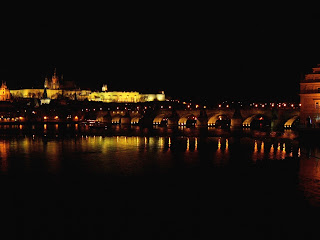
Night view of Prague Castle & Charles Bridge across the Vtlava (Moldau) River
.

Crazy New Year’s Eve scene in Wenceslas Square
.
I got back to the hotel feeling dog-tired and a little ill, so I slept until noon the next day. Although I had already paid for one additional evening in my rat-hole of a hotel room, I decided that – given my cold and grouchy humor – returning to Oldenburg and sleeping in my humble but comfy bed sounded more inviting than staying put. When vacation stops becomes less interesting than "home", it's time to head homeward. I caught an afternoon train and was home in Oldenburg by midnight.

Krakow, Poland

On the bus trip from Lithuania, I sat next to a Lithuanian college kid named Justin. He had spent a year working a construction job in England, so he spoke English very well. Justin and his four friends were traveling to Krakow for a chess tournament. They all have chess scholarships at one of the Lithuanian universities and occasionally travel to tournaments in neighboring countries. We had an interesting conversation about Lithuanian culture and their stereotypes of other nationalities.
.
A movie – “Along Came Polly” (Jennifer Aniston & Ben Stiller) – was shown during the first half of the bus ride. Something interesting about watching English-language movies in Lithuania: Instead of using subtitles or fully dubbing the language into Lithuanian, they turn the soundtrack down to about half volume and then use just one person to translate everything that’s being said (overlaid with a louder soundtrack). So you hear the English (softly), as well as the translator’s voice over-top. .
The bus stopped every 60-90 minutes throughout the night to let people off or on. And each time the bus stopped, half of the occupants filed off for a smoke break… so due to frequent interruptions and non-reclining seats, I didn’t get a lot of sleep on the bus ride. I arrived in Krakow at around 6am on December 27.
.
I had booked a hostel online and (with a map and a little assistance from an info desk) was able to walk there from the bus station. I ate breakfast with several other hostellers before I took a four-hour nap. One of my breakfast companions was an American woman named Silvana, who is currently serving a two-year term in the Peace Corps in Romania. Around ten of her Peace Corps-Romania comrades were also staying in Krakow for a week – most at our hostel and a few at a different place. Since I had the Peace Corps experience in common with them, and since they were nice folks, we hit it off well and chummed around together for much of my Krakow visit.
.
On my first evening in Krakow, I joined the Peace Corps crowd to a bar that one of their American friends who currently lives in Krakow recommended. It was great little pub with a back room, where locals played their guitars and sang their favorite folk songs and sea shanties. Some of the music was quite beautiful and haunting. Here’s a pic and a sample clip from the jam session (sorry, the sound quality is poor).
.
Krakow musicians having a folk music jam
.
.
On my second day in Krakow, I went with Silvana and a French hostel friend to visit the concentration camps at Auschwitz. It was sobering experience and one that I don’t regret having, but I think I would rather visit at a time when there were not quite so many tourists. There were huge mobs of people trying to see the site, so it was very noisy and bustling with lots of activity… it was, therefore, a little hard for me to feel particularly meditative or emotional about what I was seeing or what it represented. It was also nostril-hairs-bitter-freezing cold that day, so it was a little tough to think about much besides how cold my hands and ears were. But part of the plight of the camp prisoners was getting through the fiercely cold winters... so from that standpoint, I guess I got a more “realistic” taste of the camps than if I’d gone during a more comfortable time of the year.
.
Entrance Gate to Auschwitz #1: "Arbeit macht frei" [Work makes one free]
.
Bitter cold Auschwitz camp #2
.
On my third day in Krakow, I wandered around the town alone, taking pictures, and then went out for dinner with the Peace Corps group. I had to leave early in the morning on a train for Prague, so I didn’t stay out late partying with them. The PC bunch was a really nice group of people, and spending time with them made my Krakow visit very enjoyable. Plus, Krakow is a beautiful city with a lot of charm and plenty to see, so I recommend it as a vacation destination. And the hostel where I stayed -- Flamingo Hostel – was also great, so I highly recommend it as well.
.
Wawel Royal Castle in Krakow
.
View of the Krakow from the castle wall
.
Wistula River from the castle hill
.
Indian food dinner with the Peace Corps-Romania crew (photo by Silvana Guberti)
.

Krakow's Old Town at night
.

Main square and stage where the New Years Eve festivities would take place (a few days later)